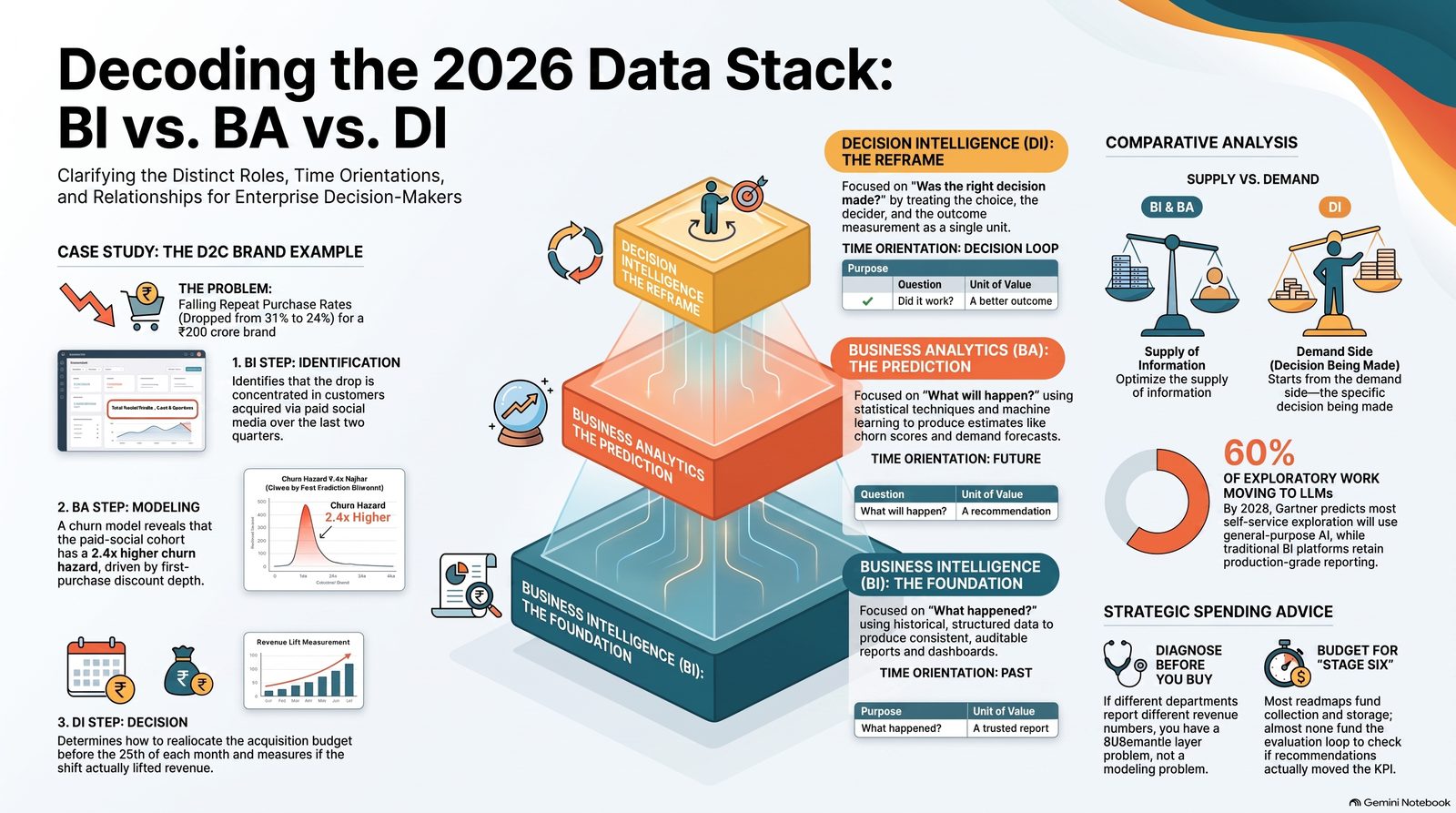
Business intelligence reports what happened, business analytics predicts what's likely to happen next, and decision intelligence designs the decision itself — treating the choice, the decision-maker and the outcome measurement as one unit. The honest question for most enterprises in 2026 isn't which layer to buy, it's whether the BI foundation underneath is trustworthy enough to build anything else on top of it.
Ask five people in an Indian enterprise to define business intelligence and you will get five answers, at least two of which describe business analytics. It sounds like a semantic quibble. It is not. Vendor contracts get signed on these definitions, and teams end up buying a reporting tool when they needed a modelling platform, or vice versa.
Here is the distinction that holds up in practice.
Business intelligence: the foundation layer
BI is concerned with what already happened. It sits on historical, mostly structured data and produces reports, dashboards and scheduled summaries. Its virtues are the unglamorous ones — consistency, repeatability, auditability.
A BI system answers questions like: what was gross margin by product category last quarter, how many active users did we have in March, which branches missed target.
Notice that every one of those questions has exactly one correct answer, and the value of BI lies in everyone in the organisation getting the same one. That is harder than it sounds. Two teams computing "active users" with different definitions is the single most common cause of analytics distrust in mid-sized firms.
BI has not gone away in 2026, and the vendors pushing AI hardest have quietly made this clear. Gartner's own framing predicts that by 2028 around 60% of self-service analytics users will reach for general-purpose LLMs for exploratory work — while production-grade reporting stays in traditional BI platforms. Exploration and reporting are different jobs.
Business analytics: the forward-facing discipline
Business analytics contains BI and extends past it. Where BI describes, BA models. It brings statistical technique and machine learning to bear on the same data and produces something BI cannot: an estimate of what has not happened yet.
Typical BA outputs — a churn probability score per customer, a demand forecast with confidence intervals, a price elasticity curve, a credit risk band.
The skill profile differs too. BI work rewards precision, domain fluency and an eye for how people misread charts. BA work rewards statistical judgement and a healthy suspicion of your own model. Both matter. Organisations that hire only the second kind end up with elegant models and no one who noticed the source table had been silently stale for six weeks.
Decision intelligence: the reframe that actually helps
Decision intelligence (DI) is the newest of the three and the most frequently dismissed as a buzzword. That dismissal is a mistake, because DI fixes a genuine and expensive blind spot.
BI and BA both optimise the supply of information. DI starts from the demand side: what decision is being made, by whom, on what cadence, under what constraints, and how will we know afterwards whether it was a good one?
Reframed this way, some uncomfortable things become visible. A dashboard that is technically perfect and viewed by nobody is not 80% successful — it contributed zero decisions. A forecast delivered on the 12th when the purchase order is raised on the 5th is not a slightly late forecast; it is a useless one.
The 2026 decision intelligence market has split into two rough camps. One builds structured, rules-driven decision automation for high-volume repeatable choices — the vendors Gartner tends to position as leaders here work in decision modelling, rules engines and governance frameworks. The other tries to support ad-hoc executive reasoning, the "why did margin compress and what do we do" conversation, which is a fundamentally different and much less solved problem.
Knowing which camp you need is most of the buying decision.
How the three relate
Think of it as widening scope rather than a replacement sequence:
| Question | Time orientation | Unit of value | |
|---|---|---|---|
| BI | What happened? | Past | A trusted report |
| BA | What will happen and what should we do? | Future | A recommendation |
| DI | Was the right decision made and did it work? | Decision loop | A better outcome |
You cannot skip levels. DI built on BA built on unreliable BI produces confident, well-designed, wrong decisions — faster than before.
What this means for spending
Three practical consequences.
First, diagnose before you buy. If your problem is that two departments report different revenue numbers, no amount of predictive modelling will help. That is a BI and semantic layer problem.
Second, match the tool to the layer. Reporting-first platforms and modelling-first platforms have different cost structures and different governance requirements. Buying an enterprise BI licence to run regressions is expensive; running board reporting out of notebooks is fragile.
Third, budget for stage six. Almost every analytics roadmap funds collection, storage, modelling and visualisation. Almost none funds the evaluation loop — the mechanism that checks whether recommendations were adopted and whether the KPI moved. That omission is why so many analytics functions cannot defend their headcount at budget time.
A worked example
A ₹200 crore Indian D2C brand notices repeat purchase rate is falling.
BI answer: repeat rate dropped from 31% to 24% over two quarters, concentrated in customers acquired through paid social.
BA answer: a churn model shows the paid-social cohort has a 2.4x higher churn hazard in months two to four, and discount depth at first purchase is the strongest predictor.
DI answer: the actual decision is how to allocate next quarter's acquisition budget across channels, made by the growth lead on the 25th of each month. She needs cohort-level LTV against blended CAC, delivered before the 25th, with a clear threshold for reallocation — and a review the following quarter to check whether shifting spend actually lifted retained revenue.
Same data. The third framing is the one that changes anything.
The takeaway
BI, BA and DI are not competing philosophies to pick between. They are layers, and the honest question for most Indian enterprises in 2026 is not "should we move to decision intelligence" but "is our BI layer trustworthy enough that anything built on top of it will be".
If the answer is no, that is where the budget goes first.
Same data. The third framing is the one that changes anything.
Referenced in this piece: Gartner — Top Predictions for Data and Analytics.
Want this level of rigor applied to your own analytics stack?
This guide comes from running BA/BI systems audits for real Indian enterprises — where the actual fix is decided by which stage of your analytics function is broken, not by which tool has the best demo. A Systems Audit tells you exactly where to start.
Book a Systems Audit arrow_forward