A functioning analytics organisation needs four distinct capabilities — data engineer (pipeline), data analyst (question), data scientist (model), senior business analyst (translation) — whether or not they map to four separate job titles. Governance isn't documentation; it's the actual mechanism by which people come to believe the number, and without it adoption stalls no matter how much you spend on tooling.
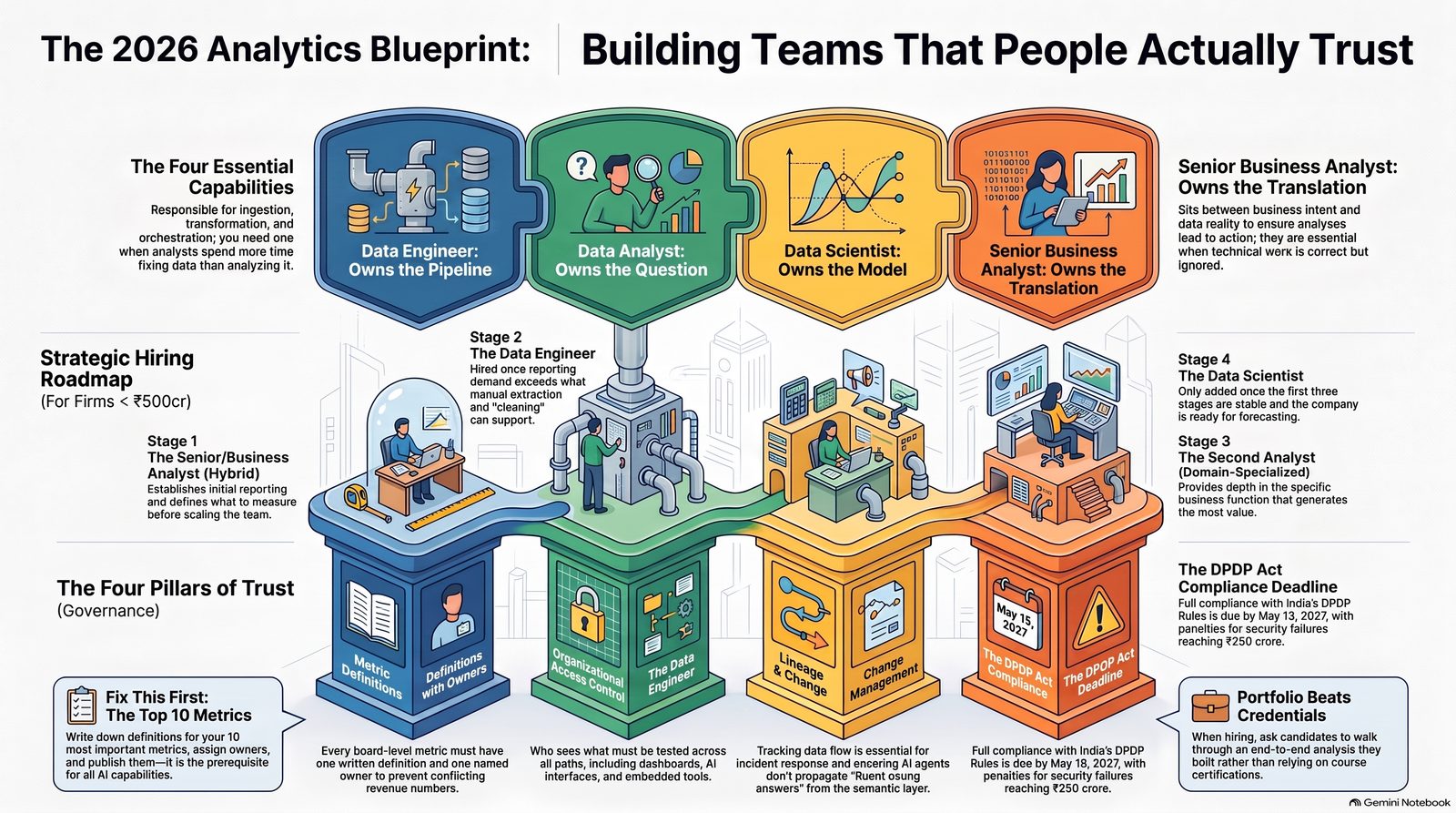
The four standard analytics job titles get used interchangeably in Indian job postings to a degree that borders on comedy. I have seen a listing titled "Data Scientist" whose responsibilities were entirely Excel reporting, and one titled "Business Analyst" that expected production Spark pipelines.
This matters beyond hiring frustration. If you do not know which capability you are missing, you will hire the wrong person and conclude that analytics does not work at your company.
Here is what each role actually owns.
The four capabilities
Data engineer — owns the pipeline. Ingestion, transformation, orchestration, warehouse modelling, observability. Their output is reliable, well-modelled data arriving on schedule. Core skills: SQL at depth, Python, dbt, orchestration tooling, cloud warehouse internals, and increasingly streaming.
The tell that you need one: your analysts spend more time fixing data than analysing it.
Data analyst — owns the question. Translating a business question into an analysis, executing it, and communicating the result. SQL, a BI platform, statistical literacy, and the underrated skill of knowing when a result is too clean to be true.
The tell: business teams are making decisions on gut feel because nobody has time to look at the numbers.
Data scientist — owns the model. Predictive and prescriptive work. Statistical modelling, machine learning, experimental design, Python or R, and the discipline to validate rather than to impress.
The tell: you have reliable descriptive and diagnostic capability and are now leaving money on the table by not forecasting.
Note the ordering. Hiring a data scientist before you have engineering and analyst capability is the most expensive sequencing error in the field. They will spend eighteen months building pipelines badly and leave.
Senior business analyst — owns the translation. The most misunderstood and often most valuable role. They sit between business intent and data reality: framing the actual problem, defining metrics, challenging whether the requested analysis answers the real question, and ensuring the output reaches a decision.
Skills are more diagnostic than technical — domain fluency, stakeholder management, metric design, enough SQL and BI capability to be self-sufficient on 80% of questions.
The tell: analyses are technically correct and nobody acts on them.
Sequencing for Indian mid-market firms
Realistic hiring order for a company under ₹500 crore revenue starting from near zero:
| Stage | Hire | Why |
|---|---|---|
| 1 | Senior analyst or business analyst (hybrid) | Establishes what to measure; can build initial reporting alone |
| 2 | Data engineer | Once reporting demand exceeds what manual extraction supports |
| 3 | Second analyst, domain-specialised | Depth in the function generating most value |
| 4 | Data scientist | Only once 1–3 are stable |
The most common mistake is starting at stage 4 because it is the most prestigious title, and the second most common is stopping at stage 1 and wondering why the single analyst burned out.
On the one-person team: many Indian firms run analytics with a single generalist. This is survivable and often correct at small scale. What is not survivable is pretending that person covers all four capabilities. Decide explicitly which ones you are choosing not to have, and accept the consequences knowingly.
Governance is what makes people believe the number
Data governance has an image problem. It sounds like committees producing documents nobody reads. That version exists and is worthless.
Functional governance is narrower and more practical: the mechanisms by which an organisation agrees on what its numbers mean and who is accountable for them.
Four components that earn their keep:
Metric definitions with owners. Every metric that appears in a board pack or an incentive calculation has one written definition, one named owner, and a change process. Without this, two teams reporting different revenue numbers is inevitable, and after it happens twice people stop trusting all reporting.
Access control that reflects the org. Who sees what, tested against every access path — including the AI and embedded paths, not just the dashboard.
Lineage. What feeds this, what depends on it. Operationally essential for incident response and legally essential for demonstrating that a data principal's erasure request actually propagated.
Change management on the semantic layer. In 2026 the semantic layer is the substrate every AI feature reads from. Ungoverned changes there propagate silently into every conversational answer.
Why this is now urgent rather than merely good practice
Governance stopped being optional for two reasons that arrived at once.
AI amplifies whatever it is grounded in. A conversational analytics layer over ungoverned data produces fluent wrong answers at speed. Gartner's 2026 predictions warn that by 2030 half of AI agent deployment failures will stem from insufficient governance runtime enforcement and interoperability gaps, with near-term ungoverned LLM-driven decisions causing financial and reputational loss. The recommendation is to experiment in controlled, low-risk environments and build a required evaluation stage into analytic workflows.
Indian regulation now has dates and numbers. The DPDP Rules, 2025 were notified 13 November 2025. Consent Manager registration under Rule 4 becomes operational 13 November 2026, with full substantive compliance due 13 May 2027. Penalties under the Act's Schedule reach ₹250 crore for security safeguard failures and stack across categories.
Governance is the mechanism through which an analytics function demonstrates compliance rather than asserts it.
The market context for hiring
Indian analytics hiring remains competitive, and published figures vary considerably by source — salary aggregators, training providers and industry bodies report meaningfully different ranges, and many circulate demand projections without primary sourcing. Treat any single number you encounter with appropriate scepticism, including in this article.
What is consistently reported across sources is directional: demand at the mid-level continues to exceed the supply of genuinely qualified candidates, and candidates combining SQL, Python and a BI platform with actual portfolio work command a premium over those with certifications alone.
For hiring managers, the practical implication is that portfolio evaluation beats credential screening. Ask a candidate to walk through an analysis they built end to end, including what went wrong. The answer separates people who have done the work from people who have completed a course.
The one thing to fix first
If you take a single action: write down the definitions of your ten most important metrics, assign each an owner, and publish the list.
It costs a week. It will surface disagreements you did not know existed. And it is the prerequisite for every AI capability you will buy in the next two years.
If you do not know which capability you are missing, you will hire the wrong person and conclude that analytics does not work at your company.
Referenced in this piece: Gartner — Top Predictions for Data and Analytics.
Want this level of rigor applied to your own analytics stack?
This guide comes from running BA/BI systems audits for real Indian enterprises — where the actual fix is decided by which stage of your analytics function is broken, not by which tool has the best demo. A Systems Audit tells you exactly where to start.
Book a Systems Audit arrow_forward