Embedded analytics puts insight inside the CRM or ERP screen where work already happens, instead of a separate BI portal nobody opens — and adoption is the difference. Real-time and edge processing are justified only when round-tripping to a central cloud costs more latency than the decision can absorb; for most operational decisions, the right answer is 'inside the application they already have open, with a number that's a day old,' which is a cheaper and higher-return project than it sounds.
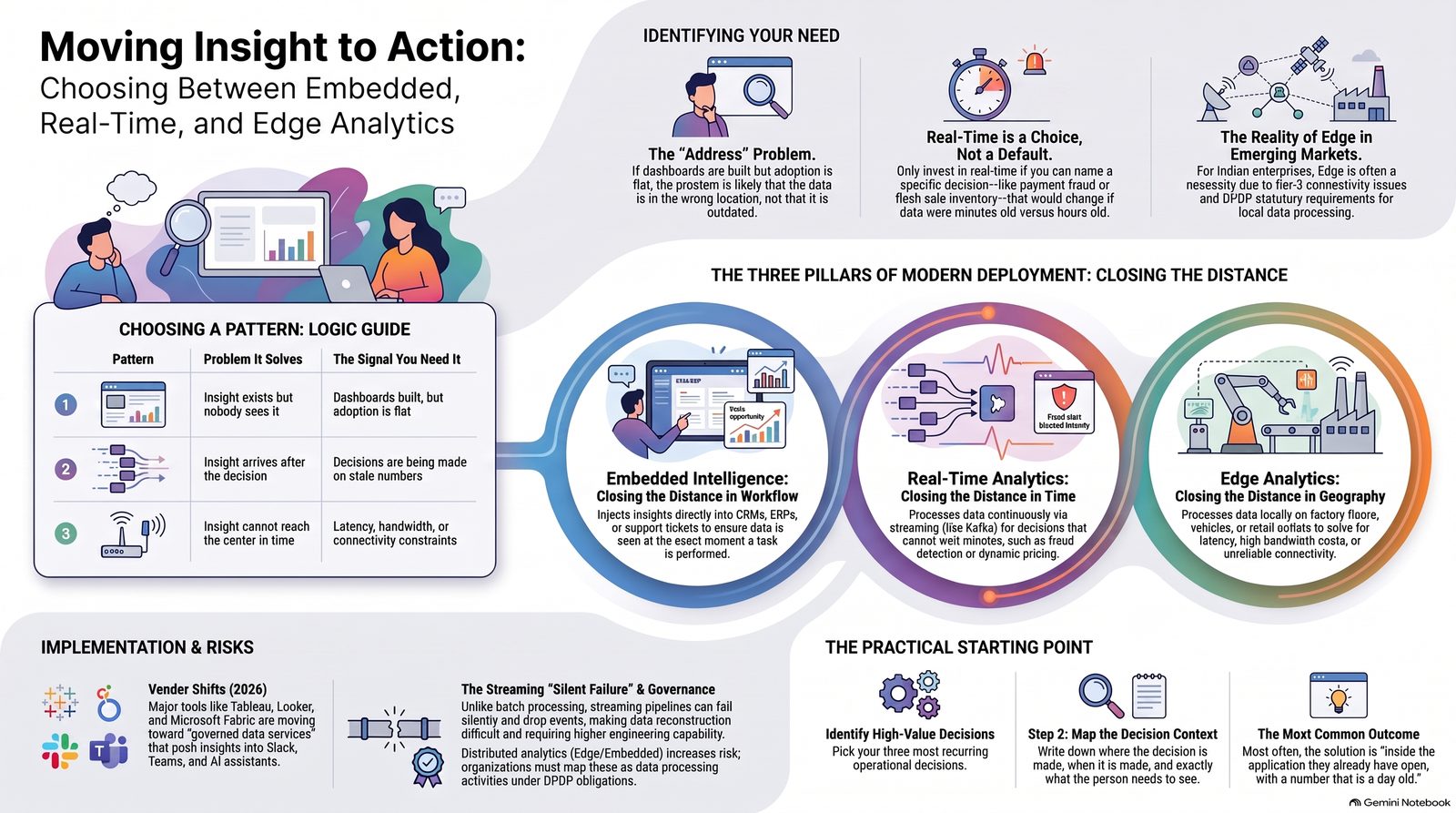
Here is a pattern worth noticing. Ask an analytics team how their flagship dashboard is performing and they will tell you about load times and data freshness. Ask the sales manager it was built for and she will tell you she has not opened it in six weeks, because opening it means leaving the CRM where she spends her entire day.
Nothing was wrong with the dashboard. The problem was its address.
This is the reasoning behind the three deployment patterns that dominated enterprise analytics in 2026 — embedded intelligence, real-time processing and edge analytics. Each moves analysis closer to the moment of decision, along a different axis.
Embedded intelligence: closing the distance in workflow
Embedded analytics injects insight directly into the operational application — the CRM record, the ERP screen, the support ticket, the warehouse management console — rather than requiring a trip to a separate BI portal.
The adoption effect is straightforward and large. A churn risk score displayed on the account record gets seen by every rep who opens that account. The same score in a dashboard gets seen by whoever remembers to check.
Vendor direction reflects this. Tableau's 2026 announcements pushed governed semantics out into Slack, Microsoft Teams and Google Workspace, and into third-party AI assistants, on the explicit premise of meeting teams where they work. Looker extended Conversational Analytics into Looker Embedded, so product teams can ship natural language querying inside their own applications through a low-code iframe or SDKs, with multi-Explore querying and custom theming. Microsoft's Fabric IQ brings Power BI semantic model answers into Microsoft 365 Copilot Chat.
The common thread is that the BI tool is becoming a governed data service rather than a destination.
When embedding is the right answer: the decision is made inside another application, on a recurring basis, by someone whose job is not analysis. Which describes most operational decisions in most companies.
What it demands: a semantic layer, because embedded insight has no analyst standing beside it to catch a wrong number, and permissions that resolve correctly in the host application's context.
Real-time analytics: closing the distance in time
Real-time analytics processes and serves data continuously rather than in scheduled batches, typically via streaming infrastructure such as Kafka.
The honest observation is that far more organisations want real-time than need it. The test is specific: name a decision that would be made differently if the data were minutes old rather than hours old, and name the person who makes it.
Genuine cases exist and are easy to recognise. Payment fraud scoring, where the decision window is the length of a transaction. Dynamic pricing in ride-hailing or quick commerce. Manufacturing line quality control. Inventory allocation during a flash sale. Network operations.
Non-cases are equally recognisable. Monthly management reporting. Quarterly cohort analysis. Anything reviewed in a weekly meeting. Building streaming infrastructure for these consumes engineering capacity that could have gone to fixing the data quality problems undermining the batch reports you already have.
The cost people underestimate: streaming systems have different failure modes than batch. A batch pipeline that fails is rerun. A streaming pipeline that fails silently drops events, and reconstructing what was lost is genuinely hard. Operating streaming well requires capability, not just tooling.
Edge analytics: closing the distance in geography
Edge analytics processes data at or near its point of generation — on a factory floor, in a retail outlet, on a vehicle, at a warehouse — rather than transmitting everything to a central cloud first.
Three drivers justify it.
Latency. When the round trip to a cloud region exceeds the decision window. A quality control system rejecting a defective unit on a moving line cannot wait for a network hop.
Bandwidth economics. High-frequency sensor data is expensive to transmit and mostly uninteresting. Processing locally and sending aggregates or exceptions is cheaper by orders of magnitude.
Connectivity reality. This one matters disproportionately in India. A manufacturing unit in a tier-3 industrial area, a cold chain vehicle on a highway, a retail outlet in a small town — none can assume reliable continuous connectivity. Edge processing means operations continue during outages and reconcile afterwards.
Gartner's 2026 predictions note an expectation that by 2029 AI agents will generate substantially more data from physical environments than from digital use cases — movement, spatial context, agent interactions. If that direction holds, edge processing shifts from optimisation to necessity, because centralising that volume is not economically viable.
Choosing between them
They are not alternatives; they answer different questions.
| Pattern | Problem it solves | Signal you need it |
|---|---|---|
| Embedded | Insight exists but nobody sees it | Dashboards built, adoption flat |
| Real-time | Insight arrives after the decision | Decisions made on stale numbers |
| Edge | Insight cannot reach the centre in time or budget | Latency, bandwidth or connectivity constraints |
Most Indian mid-market organisations have an embedding problem and believe they have a real-time problem. The tell is simple: if your existing daily reports are already sufficient for the decisions being made, and the issue is that nobody looks at them, adding streaming will not help.
The governance consequence
Distributing analytics distributes risk. Every embedded surface is a place where the wrong person might see the wrong data, and every edge node is a place where personal data might be processed outside your central controls.
For Indian enterprises this intersects directly with DPDP obligations, where reasonable security safeguards and demonstrable control over processing are statutory requirements with substantial penalty exposure. An analytics widget embedded in a partner-facing portal is a data processing activity, and it needs to be mapped as one.
The practical starting point
Before building anything, pick your three highest-value recurring operational decisions. For each, write down where the decision is made, when it is made, and what the person needs in front of them at that moment.
Most of the time the answer will be "inside the application they already have open, with a number that is a day old". Which is an embedding project — cheaper, faster and higher-return than the streaming architecture that sounded more impressive.
Nothing was wrong with the dashboard. The problem was its address.
Referenced in this piece: Tableau — agentic analytics platform.
Want this level of rigor applied to your own analytics stack?
This guide comes from running BA/BI systems audits for real Indian enterprises — where the actual fix is decided by which stage of your analytics function is broken, not by which tool has the best demo. A Systems Audit tells you exactly where to start.
Book a Systems Audit arrow_forward