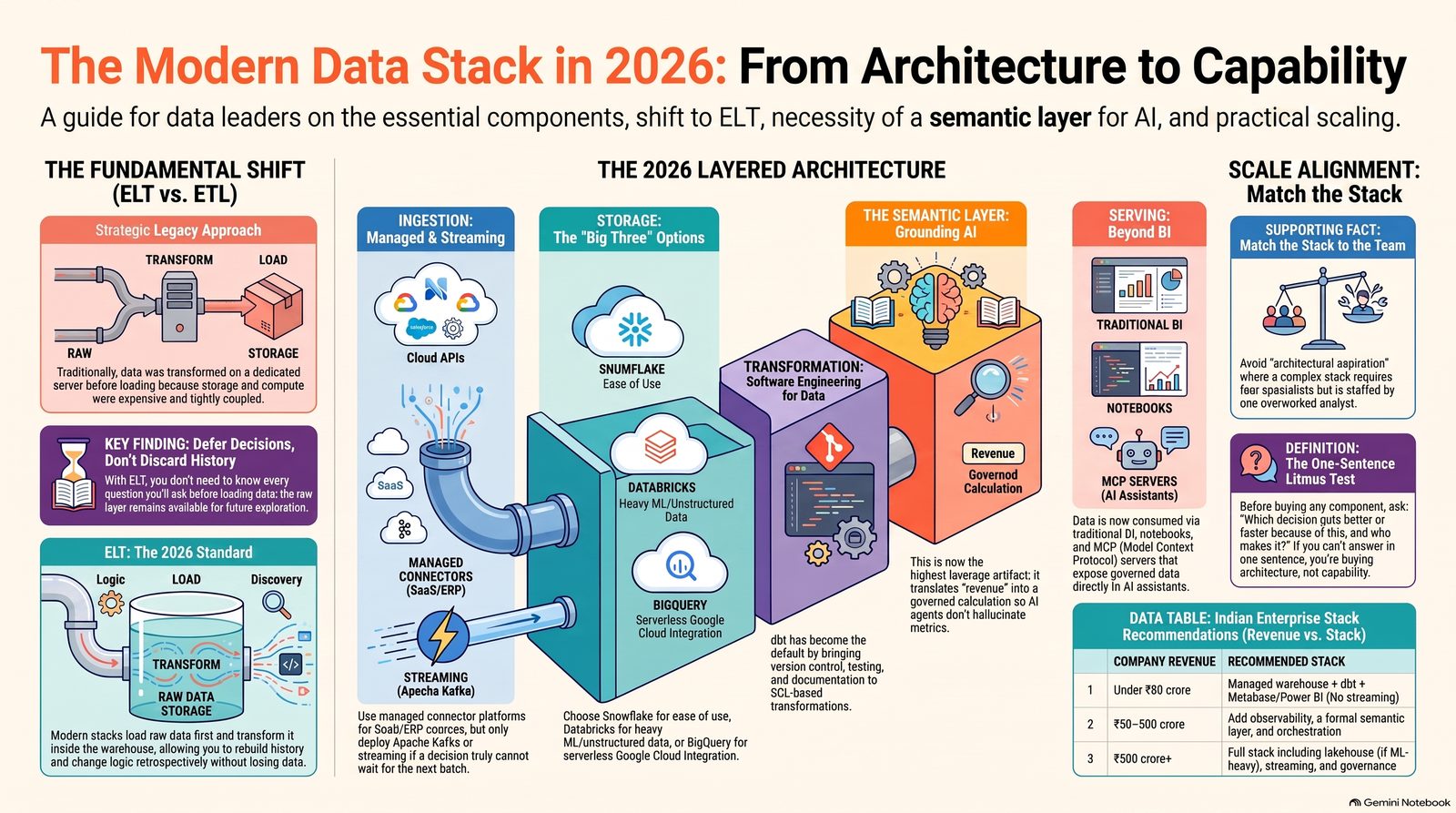
The 2026 modern data stack has settled into a stable shape: cloud-native ELT (extract, load raw, transform inside the warehouse) instead of ETL, a warehouse or lakehouse, dbt for transformation, and a semantic layer underneath everything else. Before buying any component, ask which specific decision gets better or faster because of it, and who makes that decision — if you can't answer in one sentence, you're buying architecture instead of capability.
The phrase "modern data stack" has been diluted into meaninglessness by vendors who use it to mean "our product plus five things we integrate with". Stripped of marketing, it describes a genuine architectural shift that happened over the last decade and has now settled into a fairly stable shape.
Here is that shape, and — more usefully — how to decide which parts you actually need.
The shift that defines it: ETL to ELT
Traditional data warehousing transformed data before loading it. Extract from source, transform on a dedicated server, load the finished result. This made sense when warehouse storage and compute were expensive, tightly coupled, and provisioned in advance.
Cloud warehouses decoupled storage from compute and made both elastic. That inverted the logic. Now you extract, load raw, and transform inside the warehouse — ELT.
The benefits are not obvious until you have lived with both. With ELT you retain the raw layer, so when you discover your revenue recognition logic has been subtly wrong for eighteen months, you rerun the transformation and rebuild history. With ETL, the raw data was discarded at load time and history is unrecoverable.
You also get to defer decisions. You do not need to know every question you will ask before you load the data.
Layer by layer
Ingestion. Getting data in. Managed connector platforms handle the SaaS and database sources — CRM, ERP, payment gateways, ad platforms. For event data and anything latency-sensitive, Apache Kafka or a managed streaming equivalent. Kafka is genuinely ubiquitous at scale, though it is worth being sceptical of vendor-reported adoption statistics about it, which circulate widely without primary sourcing.
Do you need streaming? Only if a decision genuinely cannot wait for the next batch. Most cannot articulate one. Streaming infrastructure carries real operational cost and should be justified by a named decision, not by aspiration.
Storage. Three credible options in 2026.
Snowflake — mature warehouse, strong SQL ergonomics, straightforward separation of storage and compute, easiest to operate with a small team.
Databricks — lakehouse architecture built on Delta Lake and Spark, strongest where you have significant ML workloads and unstructured data alongside tabular.
BigQuery — serverless, minimal operational overhead, natural fit if you are already in Google Cloud and using Looker.
The honest answer for most Indian mid-market firms is that all three will work, and the decision should be driven by existing cloud commitments, available skills in the local hiring market, and pricing model fit rather than by feature comparison. The differences that matter at 500 TB are irrelevant at 5 TB.
Transformation. dbt has become the default for SQL-based transformation, largely because it brought software engineering discipline — version control, testing, documentation, dependency management — to work that was previously done in undocumented stored procedures.
The testing capability is the underrated part. Being able to assert that a primary key is unique and non-null, in code, in CI, catches an entire category of silent failure.
Semantic layer. This has moved from optional to central, and the reason is AI. When a natural language interface asks your data a question, something must translate "revenue" into a specific, governed calculation. That something is the semantic layer.
Looker made this its architectural bet years ago with LookML, and Google's 2026 positioning leans hard into it — the argument being that in a world where hallucinated metrics can cause real damage, a code-based semantic layer is what keeps agents grounded in verified enterprise truth. Microsoft's equivalent is the Fabric semantic model, and Salesforce ships Tableau Semantics as an AI-infused layer inside Data 360.
Whatever the vendor, the principle holds: the semantic layer is now the highest-leverage artefact in your stack, because everything AI-driven inherits its quality.
Serving and consumption. BI tools, notebooks, reverse ETL back into operational systems, and increasingly MCP servers exposing governed data to AI assistants directly. Tableau's MCP servers are generally available for Next, Cloud and Server; Looker offers a Managed MCP capability, which Google cites PayPal using to scale conversational analytics to over 3,000 users through Claude Desktop.
Observability. Monitoring across the whole thing. Covered separately, but note it belongs in the architecture diagram from day one rather than being retrofitted after the first bad incident.
What you probably do not need
A dose of realism, because the reference architecture diagrams are drawn for companies far larger than most readers.
If you are under about 2 TB with batch-tolerant decisions, you likely do not need streaming, a lakehouse, or a separate ML platform. A managed warehouse, dbt, a BI tool and disciplined modelling will serve you well past the point where you can afford to reconsider.
The failure mode I see most often in Indian mid-market firms is architectural aspiration outrunning organisational capacity — a beautifully specified stack that requires four specialists to operate, staffed by one overworked analyst who inherited it.
Match the stack to the team you actually have, not the team in the vendor's case study.
A practical sizing guide
| Company profile | Reasonable stack |
|---|---|
| Under ₹50 crore revenue, 1–2 data people | Managed warehouse + dbt + Metabase or Power BI. No streaming. |
| ₹50–500 crore, small dedicated team | Add observability on critical tables, formal semantic layer, orchestration |
| ₹500 crore+, multiple domains | Full stack including lakehouse if ML-heavy, streaming where justified, governance function |
The question to ask before buying anything
For every component you are considering, ask: which decision becomes better or faster because of this, and who makes that decision?
If the answer takes more than one sentence, or names no specific person, you are buying architecture rather than capability. That is how organisations end up with impressive stacks and unimpressive analytics.
If the answer takes more than one sentence, or names no specific person, you are buying architecture rather than capability.
Referenced in this piece: dbt Labs — transformation tooling.
Want this level of rigor applied to your own analytics stack?
This guide comes from running BA/BI systems audits for real Indian enterprises — where the actual fix is decided by which stage of your analytics function is broken, not by which tool has the best demo. A Systems Audit tells you exactly where to start.
Book a Systems Audit arrow_forward