Metabase and Apache Superset can meaningfully undercut enterprise BI licensing for Indian teams, especially once you account for how per-seat pricing built around North American salaries lands differently here — but 'free' software has real costs in self-hosting, upgrades and operational ownership. The practical pattern: run governed, must-be-consistent reporting on a commercial platform with a small number of seats, and run wide, low-stakes exploratory analytics on open source against the same modelled warehouse.
Enterprise BI pricing has a structural problem for Indian companies. Per-user licensing designed around North American salary levels lands very differently when your analyst costs a fraction of theirs. A 60-seat deployment that reads as a rounding error to a US enterprise is a real line item to a ₹100 crore Indian firm.
This is the honest case for open-source BI, and also the honest case against it — because "free" software has costs that simply appear in a different budget.
The two serious contenders
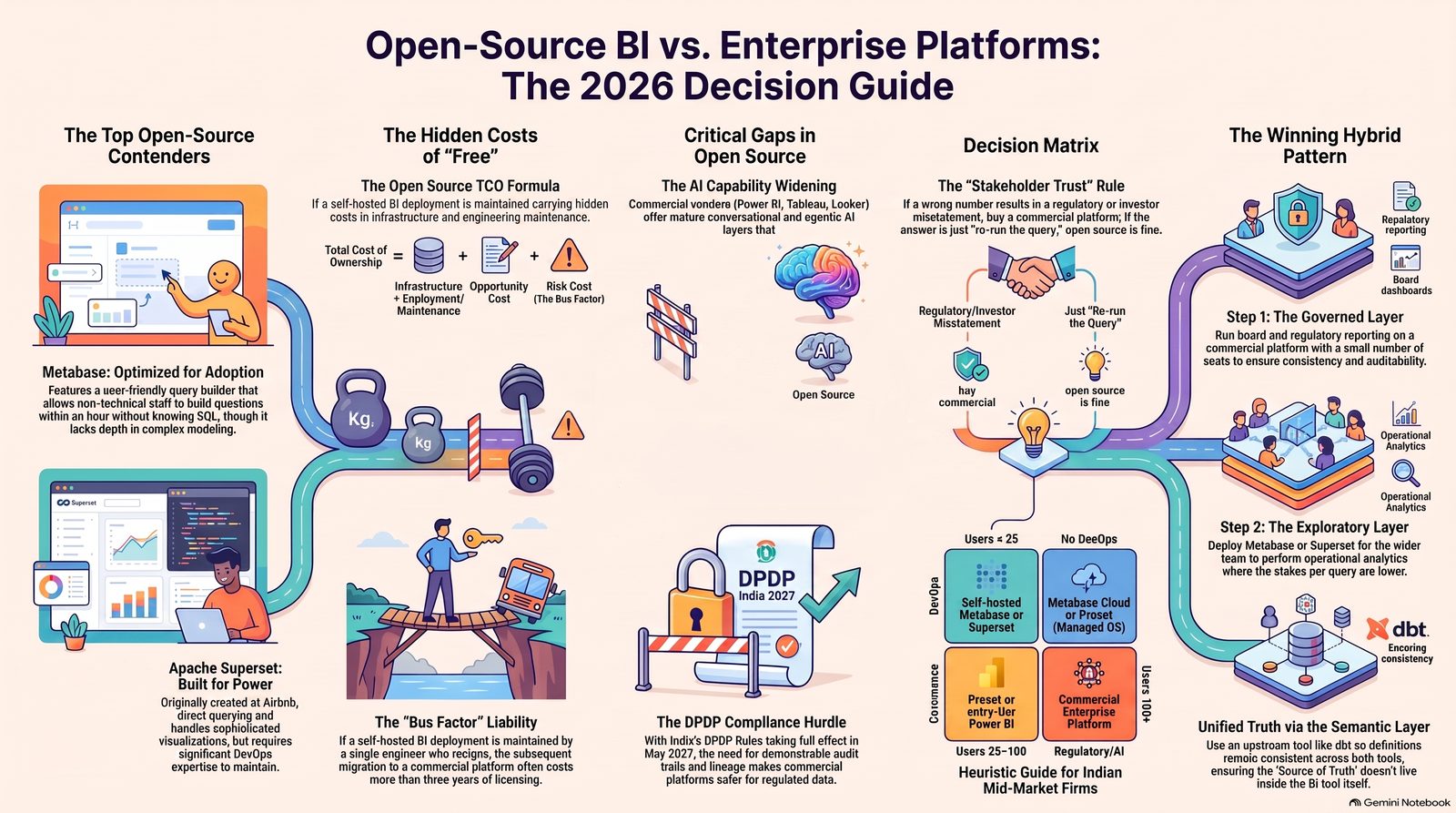
Metabase optimises for time-to-first-answer. Point it at a database, and non-technical users are building questions within the hour through a query builder that does not require SQL. It has a genuine open-source edition alongside paid cloud and enterprise tiers.
Its strength is adoption. In organisations where BI has historically failed because nobody outside the data team could use it, Metabase's low friction is worth more than any feature list.
Its limitation is depth. Complex modelling, sophisticated permission structures and heavy custom visualisation are not what it is built for.
Apache Superset is the more capable and more demanding option. Originally built at Airbnb, now an Apache project, with a commercial managed offering in Preset. It handles a wide range of visualisation types, supports SQL Lab for analysts who want to write queries directly, and scales to larger deployments.
Its limitation is operational overhead. Self-hosted Superset needs someone who understands its deployment model, its caching behaviour and its upgrade path. That person is not free.
The total cost calculation people get wrong
The mistake is comparing licence cost to zero. The real comparison is:
Open source TCO = infrastructure + engineering time to deploy + engineering time to maintain + opportunity cost of features you build yourself + risk cost of the bus factor
That last term is the one that bites. A self-hosted BI deployment maintained by one enthusiastic engineer is a liability the day that engineer resigns. I have watched this happen twice, and in both cases the migration to a commercial platform cost more than three years of licences would have.
A rough heuristic for Indian mid-market firms:
| Situation | Likely better choice |
|---|---|
| Under 25 users, has DevOps capability, cost-sensitive | Self-hosted Metabase or Superset |
| Under 25 users, no DevOps capability | Metabase Cloud or Preset — managed, still far cheaper than enterprise |
| 25–100 users, governance requirements emerging | Preset, or entry-tier Power BI |
| 100+ users, regulatory exposure, AI features needed | Commercial enterprise platform |
Where open source genuinely wins
Embedded analytics in your own product. If you are a SaaS company shipping dashboards to your customers, per-user commercial licensing becomes untenable at scale. Open source with a permissive licence is often the only viable economics.
Internal tools and operational dashboards. Analytics that nobody outside the company sees, where governance requirements are lighter, and where the cost of a wrong number is a conversation rather than a regulatory event.
Environments where data cannot leave your infrastructure. Self-hosting is not a preference here, it is a requirement, and open source handles it natively.
Teams that want to move now. Superset or Metabase can be running against a warehouse in a day. Enterprise procurement in an Indian corporate rarely completes in under six weeks.
Where it does not
When you need the AI layer. This is the decisive gap in 2026, and it is widening. The conversational and agentic capabilities that commercial vendors shipped this year — Power BI's Copilot and Fabric IQ, Tableau's Pulse and Agent, Looker's Gemini-powered Conversational Analytics — are grounded in mature, governed semantic layers that took years to build. Open-source alternatives are moving, but not at that pace, and a natural-language layer without a semantic layer beneath it produces exactly the confident-wrong-answer problem that makes stakeholders stop trusting analytics entirely.
When governance must be demonstrable. For Indian enterprises heading toward the DPDP Rules' full compliance date of 13 May 2027, the ability to evidence access controls, lineage and audit trails matters. Open source can achieve this. It will not achieve it by default, and the gap between "can" and "does" is engineering time.
When the finance team wants predictability. Licence costs are predictable. Engineering time spent on BI maintenance is not, and it competes with roadmap work.
The hybrid pattern that works
The most sensible arrangement I have seen in Indian mid-market firms is not a choice at all.
Run the governed layer — board reporting, regulatory reporting, the metrics that must be consistent — on a commercial platform with a small number of licences. Run exploratory and operational analytics, where the audience is wide and the stakes per query are low, on Metabase or Superset against the same warehouse.
Both read from the same modelled tables. The semantic definitions live upstream in dbt, so they are consistent regardless of which tool renders them. You pay enterprise pricing only for the seats that genuinely need enterprise capability.
This works because the semantic layer is the thing that matters, and it does not have to live inside the BI tool.
The decision rule
Ask what happens when a number on this dashboard is wrong.
If the answer is "someone re-runs the query", open source is fine. If the answer is "we misstate results to a regulator or an investor", buy the platform with the audit trail — and stop treating the licence as the expensive part of the decision.
The semantic layer is the thing that matters, and it does not have to live inside the BI tool.
Referenced in this piece: Apache Superset — official project site.
Want this level of rigor applied to your own analytics stack?
This guide comes from running BA/BI systems audits for real Indian enterprises — where the actual fix is decided by which stage of your analytics function is broken, not by which tool has the best demo. A Systems Audit tells you exactly where to start.
Book a Systems Audit arrow_forward