Power BI, Tableau and Looker all make perfectly good charts now — the 2026 decision is really about which platform's AI layer you can trust, and that comes down to semantic architecture and licensing rather than visualisation. Power BI's Copilot requires an F64-or-higher Fabric capacity, Tableau leans on analyst-driven modelling, and Looker enforces metric consistency through LookML at the cost of needing engineering discipline to run it.
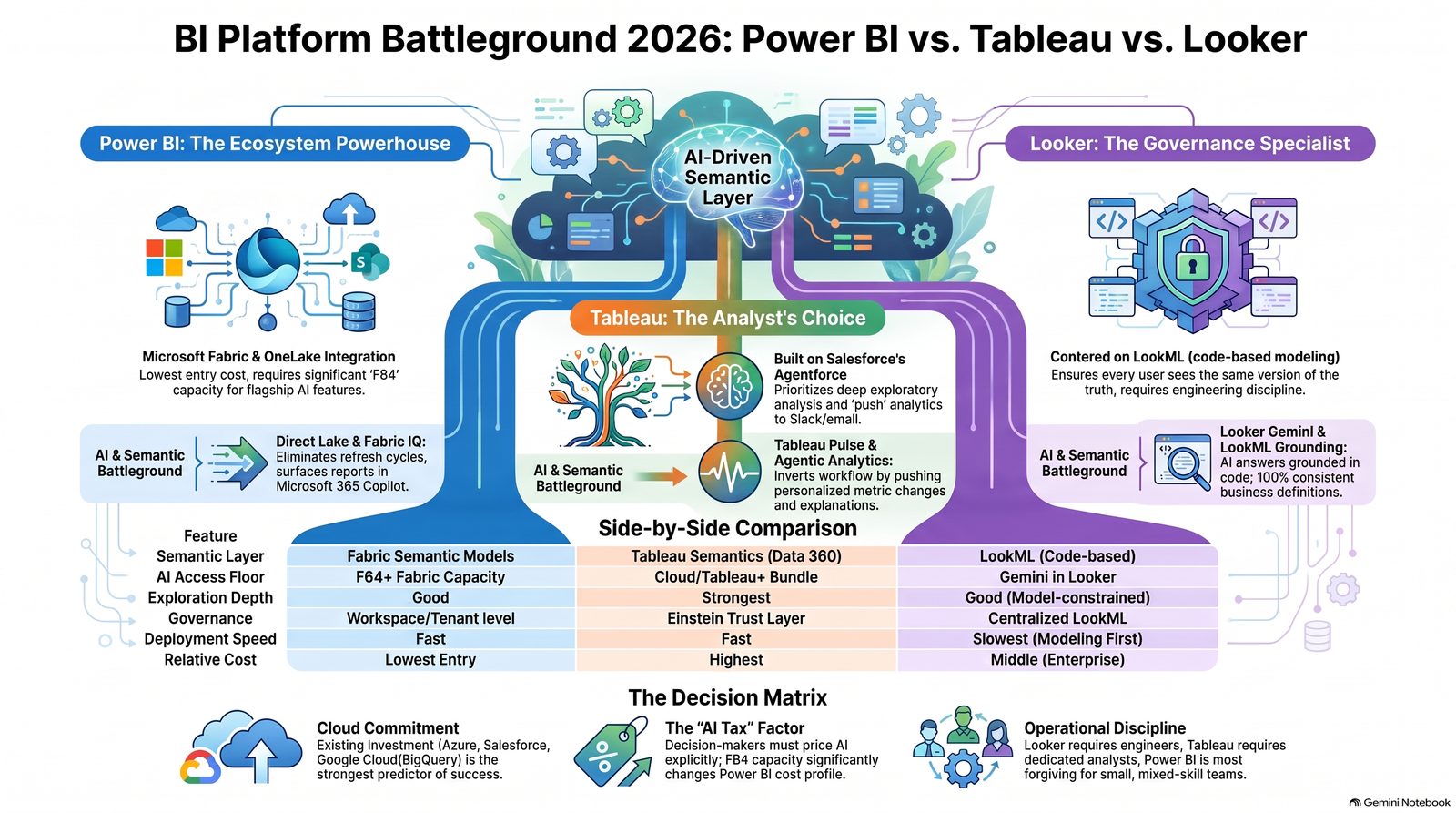
Every comparison of these three platforms written before 2024 is now obsolete, because all three have been rebuilt around a different premise. The question is no longer which one makes better charts. All three make perfectly good charts and have for years.
The question in 2026 is which one's AI layer you can trust, and that turns out to be a question about semantic architecture and licensing rather than visualisation.
Gartner published its Magic Quadrant for Analytics and BI Platforms on 29 June 2026, and the market description had visibly moved toward agentic AI, governed semantics and AI-augmented decision support. All three platforms below were publicly announced as Leaders, alongside others including Qlik and ThoughtSpot. Microsoft noted it was its nineteenth consecutive year as a Leader.
Microsoft Power BI
Architecture. Power BI in 2026 is inseparable from Microsoft Fabric. The significant capability is Direct Lake storage mode, which queries Delta Parquet data sitting in OneLake without importing it — eliminating refresh cycles while keeping performance closer to import mode than DirectQuery manages. Direct Lake reached general availability and its earlier drillthrough limitations were removed during the 2026 cycle.
AI layer. Copilot across Desktop and Service, plus the newer Fabric IQ, which surfaces Power BI semantic models inside Microsoft 365 Copilot Chat. Because Fabric IQ connects to existing Fabric and Power BI investments and respects user permissions and the same semantic models, answers stay consistent with what users see in reports.
The licensing catch, which decides most evaluations. Copilot in Power BI requires a Microsoft Fabric capacity at F64 or higher, or equivalent Premium capacity, plus a Fabric-enabled workspace and tenant admin enablement. That is a meaningful spend floor. Microsoft also recommends Import or Direct Lake modes for Copilot rather than DirectQuery, where response latency and row-level-security inconsistencies degrade the experience.
Best fit. Organisations already committed to Microsoft 365 and Azure. The integration advantage is real and the per-user entry cost is the lowest of the three — provided you do not need Copilot, at which point the capacity requirement changes the arithmetic entirely.
Tableau
Architecture. Tableau's VizQL engine remains the strongest pure analytical exploration experience of the three; analysts who have used all three generally concede this. Tableau Next, the newer cloud-native platform, is built on Salesforce's Agentforce platform with Data 360 as the unified data layer and Tableau Semantics as the semantic layer.
AI layer. This is where Tableau moved most aggressively in 2026. In May, Salesforce announced an agentic analytics platform spanning Cloud, Server, Desktop and Next.
Tableau Pulse inverts the analytics workflow: instead of users hunting through dashboards, personalised metric changes and anomaly explanations are pushed to them, delivered into Slack and email. Its 2026 capability set includes proactively surfacing anomaly root causes. Pulse now supports dark mode and tracks who last changed a metric definition — a small governance feature that matters more than it sounds.
Tableau Agent in Pulse handles conversational analytics, and Tableau MCP servers are generally available across Next, Cloud and Server. Integrations released in 2026 bring Tableau's curated semantic models into Microsoft Teams, Slack, Google Workspace, and into third-party AI assistants including Claude and ChatGPT via marketplace connectors.
All AI processing runs through the Einstein Trust Layer, keeping data within the Salesforce and Tableau environment.
Best fit. Salesforce-centric organisations, and analytics teams where deep exploratory analysis is a core activity rather than an occasional one. Pricing is the highest of the three, and Pulse is cloud-only — no path for on-premise-bound deployments.
Looker
Architecture. Looker's defining choice is LookML, a code-based semantic layer that defines metrics once, centrally, in version control. Everything else follows from that decision.
Historically this made Looker slower to deploy than its rivals, because you had to model before you could visualise. In the AI era that constraint became the advantage.
AI layer. Conversational Analytics, powered by Gemini and grounded in the LookML semantic model. Because "revenue" or "churn rate" are defined in LookML, the AI resolves them to the organisation's actual definitions rather than inferring from column names. Gemini's architecture combines semantic parsing for NL2SQL, a knowledge graph for context, and a code interpreter that generates Python for tasks like forecasting and anomaly detection.
Looker connects through to BigQuery, AlloyDB, Redshift, Snowflake and Databricks, so the semantic layer is not tied to a single warehouse. Conversational Analytics has also been extended into Looker Embedded, available through a low-code iframe implementation or SDKs.
Google's 2026 positioning cites customers including YouTube and Telenor running agents in production grounded in LookML, and PayPal scaling conversational analytics to over 3,000 users via Looker's Managed MCP offering.
Best fit. Organisations that value governed metric consistency above ease of first deployment, and teams with engineering discipline. Weakest fit for small teams wanting dashboards next week.
Side by side
| Power BI | Tableau | Looker | |
|---|---|---|---|
| Semantic layer | Fabric semantic models | Tableau Semantics (Data 360) | LookML — code-based, version-controlled |
| Signature AI feature | Copilot + Fabric IQ | Pulse (push) + Tableau Agent | Conversational Analytics (Gemini) |
| AI access requirement | F64+ Fabric capacity | Cloud editions / Tableau+ bundle | Gemini in Looker |
| Exploration depth | Good | Strongest | Good, model-constrained |
| Governance model | Workspace + tenant | Einstein Trust Layer | Centralised LookML |
| Deployment speed | Fast | Fast | Slowest — modelling first |
| Relative cost | Lowest entry | Highest | Middle, enterprise-oriented |
How to actually decide
Skip the feature matrix. Four questions settle it.
Which cloud are you already in? This is genuinely the strongest predictor of a successful implementation. Microsoft shop, Power BI. Google Cloud with BigQuery, Looker. Salesforce as the operational core, Tableau.
Do you have a metrics consistency problem? If different teams report different numbers for the same thing, Looker's enforced modelling discipline solves this by construction. The others can solve it, but they permit you not to.
Will you actually use the AI features? If yes, price them explicitly — Copilot's F64 requirement in particular changes Power BI's cost profile substantially. If no, the comparison collapses to visualisation and cost, and Power BI usually wins on the latter.
Who is going to operate it? Looker needs engineering discipline. Tableau needs analysts. Power BI is the most forgiving of a small, mixed-skill team.
The point everyone underweights
Every one of these vendors is now telling the same story from a different angle: the semantic layer decides whether AI-driven analytics works. Devoteam's 2026 assessment of Looker rollouts put it bluntly — failures generally trace to modelling quality rather than to the technology.
Which means the platform decision matters less than whether you are willing to do the modelling work. Choose the tool that fits your cloud and your team, then spend your energy on the semantic layer. That is where the return is.
The platform decision matters less than whether you are willing to do the modelling work.
Referenced in this piece: Gartner Magic Quadrant — Analytics and BI Platforms.
Want this level of rigor applied to your own analytics stack?
This guide comes from running BA/BI systems audits for real Indian enterprises — where the actual fix is decided by which stage of your analytics function is broken, not by which tool has the best demo. A Systems Audit tells you exactly where to start.
Book a Systems Audit arrow_forward